
From Indonesia to the World: The Indonesian Foreign Minister’s UN Speech Reaffirms President Prabowo’s Diplomatic Direction

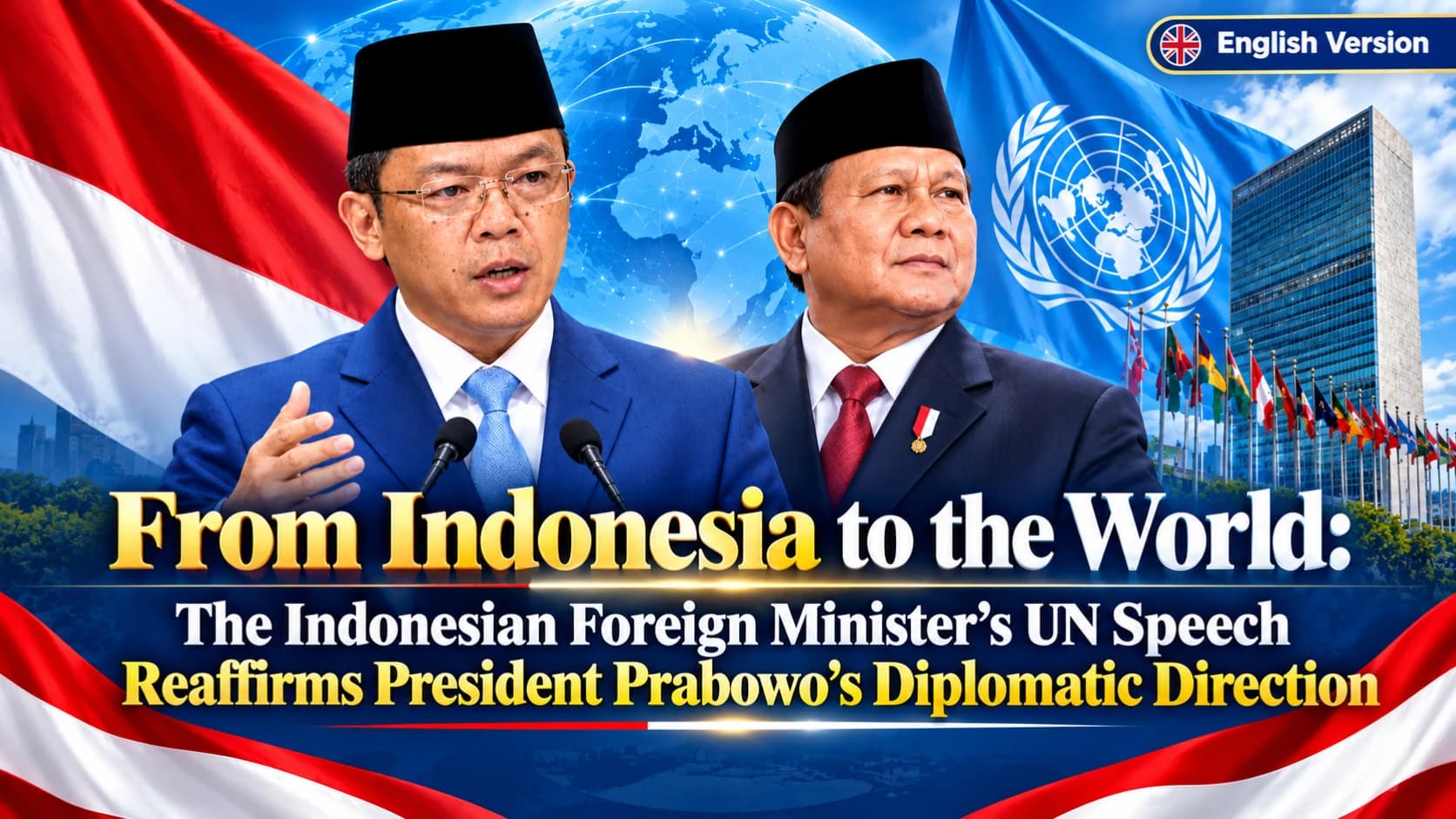
The speech delivered by Indonesian Foreign Minister Sugiono during the General Debate of the 81st Session of the United Nations General Assembly in New York on September 26, 2026, conveyed an important message: Indonesia wants to be present not merely as a spectator in global affairs, but as a country that actively contributes to building solutions.
Before a forum that brings together nations from across the world, Sugiono presented the idea that national resilience is the foundation of regional and global resilience. This approach is in line with President Prabowo Subianto’s policy direction, which places self-reliance, national resilience, and national interests at the center of Indonesia’s strategy for navigating global uncertainty.
One of the key points of Sugiono’s speech was his explanation that a nation’s resilience is not limited to military defense.
According to the position presented by Sugiono at the UN, Indonesia needs to strengthen food and energy resilience, education, healthcare, the economy, democracy, human rights, the rule of law, and unity in diversity.
This approach is highly relevant to today’s global conditions. Food and energy crises, geopolitical conflicts, and economic disruptions can have cross-border consequences. Therefore, Indonesia cannot simply call on the world to preserve peace; it must also strengthen its own national capacity to withstand various shocks.
With a population of more than 280 million people and an extensive geographical territory, Indonesia’s resilience inevitably has implications for regional stability.
Sugiono also presented ASEAN as an example of how differences in interests can be managed through communication and dialogue.
For nearly six decades, ASEAN has provided a platform for Southeast Asian countries to maintain communication despite differences in political systems, economic interests, and strategic priorities.
This message demonstrates that Indonesia continues to view diplomacy as an important instrument. Amid competition among major powers, Indonesia does not necessarily have to choose between confrontation and silence. The path being offered is to preserve space for dialogue, seek common ground, and build cooperation that produces concrete benefits.
The issue of Palestine was another important part of Sugiono’s speech. Indonesia once again reaffirmed its support for the Palestinian people’s right to self-determination and for the establishment of an independent and sovereign Palestinian state based on the Two-State Solution, international law, and internationally agreed parameters.
Sugiono also described Palestine as one of the most significant tests of the multilateral system. The message is simple but important: international law has meaning only when its principles are genuinely implemented.
This position is also consistent with Indonesia’s diplomatic actions at the United Nations. The Indonesian delegation walked out when Israeli Prime Minister Benjamin Netanyahu was scheduled to deliver his address. According to Indonesia’s Ministry of Foreign Affairs, the move represented solidarity with the Palestinian people and a protest against the situation unfolding there.
Importantly, Indonesia’s commitment to peace does not stop at speeches. UN data in 2026 shows that Indonesia is the sixth-largest contributor of uniformed personnel to UN peacekeeping missions, with nearly 2,000 military and police personnel contributing to several peace operations.
This means that when Sugiono speaks about Indonesia’s contribution to world peace, there is a concrete record behind the message.
Indonesia has deployed its personnel to international peacekeeping missions, including in regions facing conflict and instability.
Another strategic message was the announcement of Indonesia’s candidacy for a non-permanent seat on the UN Security Council for the 2029–2030 term under the theme, “Fostering Unity, Advancing Peace.”
The candidacy demonstrates Indonesia’s intention to expand its diplomatic role in international decision-making on peace and security.
Viewed in the context of the speech as a whole, this initiative does not stand alone. It forms part of a broader set of ideas: strengthening national resilience, reinforcing ASEAN, improving multilateralism, supporting Palestine, and contributing to peacekeeping missions.
It is also important that Sugiono explicitly continued President Prabowo’s call in his UN speech the previous year for countries to move closer to one another rather than become increasingly divided.
This is where Sugiono’s speech can be understood as a continuation of the diplomatic direction of President Prabowo’s administration.
President Prabowo does not have to be physically present at every international forum for Indonesia’s voice to be heard. The Foreign Minister carries out his diplomatic mandate by bringing Indonesia’s interests and positions to the global stage.
Therefore, Sugiono’s speech was not merely ceremonial. It was part of a broader effort to demonstrate that Indonesia seeks to play an active role in addressing global challenges.
What deserves particular attention in this message is the effort to connect global issues with domestic strength.
Indonesia wants to speak about peace while simultaneously strengthening food and energy resilience. Indonesia wants to play a role in multilateralism while also advocating reforms that make international institutions more representative and effective. Indonesia wants to contribute to conflict resolution while continuing to emphasize national interests and the principles of international law.
This is a diplomatic approach that seeks to position Indonesia as a confident nation: active in expressing its views, open to dialogue, yet firmly committed to its national interests.
President Prabowo and Foreign Minister Sugiono deserve positive attention for bringing these messages to the UN stage.
The world is facing multiple uncertainties. In such circumstances, Indonesia’s voice will carry greater weight when it is backed by strong national resilience, active diplomacy, and the capacity to offer cooperation and solutions.
From Jakarta to New York, Indonesia’s message is becoming increasingly clear: strong at home, active in the world, and steadfast in standing for peace.
Komentar (0)
Kami meninjau komentar untuk menjaga percakapan tetap sehat. Hindari membagikan informasi sensitif.
Belum ada komentar. Jadilah yang pertama memberi tanggapan.